
Introduction: Why Data Privacy Certification Matters in 2026
Data privacy certification is the formal, third-party verification that an organisation handles personal data in line with recognised standards of privacy protection. It goes beyond internal policies or self-assessment: an independent auditor examines your controls, processes, and documentation, then confirms they meet defined criteria. In 2026, this kind of objective proof has become a commercial necessity rather than a regulatory nice-to-have.
Since GDPR compliance became mandatory on 25 May 2018, data protection and data security have moved firmly onto the board agenda. The UK General Data Protection Regulation, the Data Protection Act 2018, and a growing web of global privacy regulations mean that organisations face real financial consequences for weak privacy practices. Fines for GDPR violations can reach €20 million or 4% of annual global revenue, and high-profile enforcement has driven the point home: the ICO fined British Airways £20 million and Marriott approximately £18.4 million for failures in technical and organisational security.
Against this backdrop, ISO IEC 27701 has emerged as the leading international standard for privacy information management. It gives organisations a structured, auditable framework to demonstrate compliance with data protection principles and build trust with customers, regulators, and partners. At Data Privacy Services (Data Privacy and Data Security Services Limited), we specialise in helping UK organisations design, implement, and certify privacy information management systems – and this article explains why ISO/IEC 27701 certification is increasingly the obvious answer.

The Commercial Case for Strong Data Protection
Privacy expectations from customers, regulators, and investors now translate directly into commercial outcomes. Organisations that can evidence mature privacy practices win tenders, close deals faster, and attract investment with less friction. Those that cannot find themselves losing ground.
Robust data protection now influences:
Procurement decisions – public-sector buyers and enterprise clients routinely require documentary evidence of privacy controls before awarding contracts
Controller-processor negotiations – data controllers increasingly demand that any data processor they engage can prove appropriate security and privacy management
Investment and M&A due diligence – acquirers and funders scrutinise privacy posture as part of risk assessment in UK and EU transactions
On the risk side, weak privacy protection exposes organisations to regulatory penalties under UK GDPR, civil claims and group litigation over mishandled personal data, and increased cyber insurance premiums or outright exclusions. The Data (Use and Access) Act 2025 aligned maximum ePrivacy penalties with UK GDPR scale – up to £17.5 million or 4% of global turnover.
The upside is equally tangible. Strong privacy information management shortens sales cycles, positions you as a low-risk supplier, and enhances brand reputation. Having standardized certifications streamlines vendor risk management for B2B companies, and certification can provide evidence for customer trust rather than relying on internal claims. Organisations handling sensitive data may gain a competitive advantage through certification, and data privacy certifications help build customer trust in data handling practices. The message is clear: unverified claims are no longer enough.
What Is Data Privacy Certification?
Data privacy certification is formal, third-party attestation of how an organisation manages personal data and complies with privacy regulations. It confirms that an independently audited privacy information management system is in place, with controls that can be evidenced – not just described on paper.
Data privacy certifications fall into two categories: individual and organizational certifications. Individual certifications include credentials like CIPP, which focuses on privacy laws and has regional versions covering specific jurisdictions, CIPM, which focuses on managing daily operations of an enterprise privacy framework, and CIPT, which emphasises integrating privacy protections into IT products and systems. Organisational certifications assess an entity’s systems and controls: for example, SOC 2 evaluates an organisation’s controls against AICPA Trust Services Criteria including privacy, while Europrivacy is a European data protection certification evaluating compliance with GDPR.
Recognised privacy seals enhance customer trust and market differentiation. Privacy certifications create consistent privacy programs with repeatable processes and controls, and they provide demonstrable evidence of regulatory compliance to data protection authorities. Under GDPR Article 42, the UK and EU envisage formal data protection certification mechanisms, yet very few sector-agnostic, ICO-approved schemes currently exist. ISO IEC 27701 certification is the most widely recognised and internationally accepted form of privacy information management certification available today.
How ISO/IEC 27701 Fits into the Data Protection Landscape
ISO 27701 is an international standard for privacy management, providing requirements for a privacy information management system that sits alongside information security standards. It integrates with ISO 27001 for data privacy controls, extending the existing information security management system framework by adding detailed privacy management and data protection requirements.
The standard aligns with key data protection principles found in UK GDPR and EU GDPR, the Data Protection Act 2018, and other privacy regulations globally. ISO 27701 helps organisations comply with multiple privacy regulations, not just one jurisdiction’s rules. Its annexes provide explicit mappings to GDPR obligations – covering lawful basis, data subject rights, transparency, breach notification, and privacy by design – making it a natural framework for managing compliance.
ISO 27701 provides a framework for managing personally identifiable information across the full lifecycle: collection, storage, use, sharing, and deletion. It helps demonstrate compliance with GDPR requirements in such a way that auditors, regulators, and partners can verify. For organisations operating internationally, frameworks like Global CBPR offer legal pathways for international data transfers, and Cross-Border Privacy Rules assist organisations in validating cross-border personal data transfers – but ISO/IEC 27701 remains the most flexible route to show mature privacy protection across borders.
Core Elements of a Privacy Information Management System (PIMS)
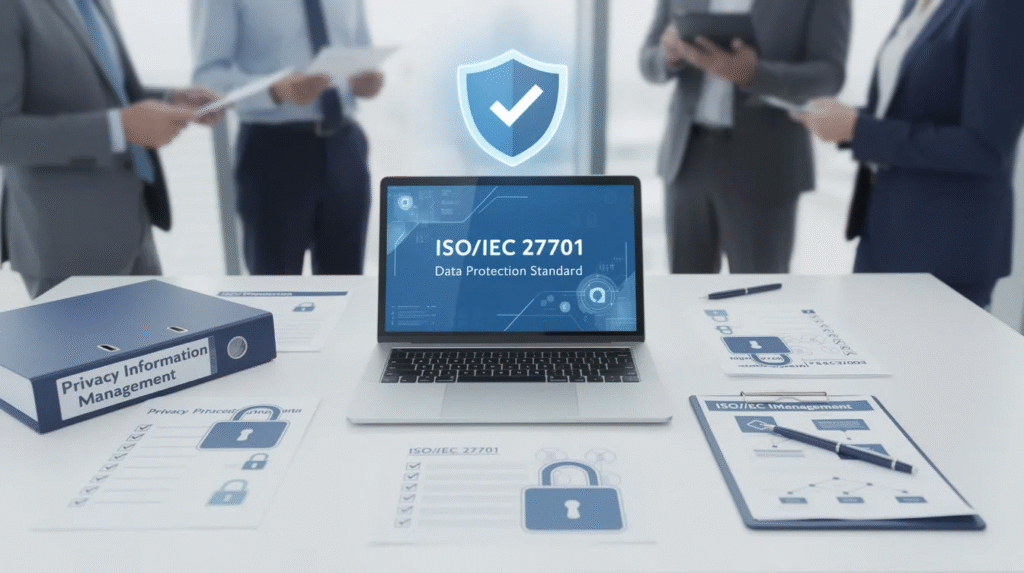
A PIMS is a structured management system for privacy information management that integrates with existing information security processes. ISO 27701 establishes requirements for a privacy information management system covering governance, risk, and operations.
The main building blocks include:
Governance and accountability – clear ownership of personal data processing, with defined roles for PII controllers and PII processors
Risk assessment – evaluating privacy impacts and data security threats through DPIAs and risk registers
Policies aligned with data protection principles – lawfulness, fairness, transparency, minimisation, storage limitation, integrity and confidentiality, and accountability
ISO/IEC 27701 differentiates requirements for data controllers (who decide purposes and means of processing) and data processors (who act on behalf of controllers). Typical operational components include data inventories and records of processing activities, supplier and processor due diligence, and data subject rights procedures covering access, rectification, erasure, objection, and portability.
PIMS helps organisations manage personally identifiable information responsibly, and implementing a PIMS mitigates risks of data breaches and non-compliance. ISO 27701 provides a framework for demonstrating compliance with privacy laws, and PIMS is suitable for organisations of all sizes and sectors – controls can be scaled proportionately to the volume and sensitivity of data an organisation processes personal data about, whether it concerns EU citizens, employees, or customers in the private sector.
ISO/IEC 27701 Certification vs. GDPR Compliance
GDPR compliance is a legal obligation. ISO/IEC 27701 certification is voluntary – but it is a powerful way to evidence that compliance with guidelines, criteria, and principles is embedded in operational practice rather than existing only in policy documents.
ISO/IEC 27701 supports compliance with UK GDPR Articles on accountability, records, DPIAs, and security of processing. It operationalises the data protection principles embedded in Article 5 and structures the roles and responsibilities of controllers and processors. ISO 27701 certification can enhance trust with stakeholders regarding data protection, because it provides independent verification against the latest industry standards.
There are limitations to be clear about. ISO/IEC 27701 is not, at present, an official “GDPR seal” – ICO-approved certification schemes remain limited and sector-specific. The certificate does not serve as a legal guarantee of compliance. However, in contracts, tenders, and regulatory inquiries, accredited certification is widely regarded as the obvious answer for establishing credible privacy practices. The practical guidance is straightforward: explain its scope clearly, avoid overstating it, and use it as a foundation to build trust with regulators, partners, and customers.
ISO/IEC 27701 and ISO/IEC 27001: Privacy and Information Security Together
Information security and data privacy are closely related but not identical. ISO/IEC 27001 is the leading standard for an information security management system, focused on protecting the confidentiality, integrity, and availability of information. ISO/IEC 27701 layers privacy information management on top, ensuring personal data is handled lawfully and transparently – not just kept secure.
ISO 27701 certification requires prior ISO 27001 certification, meaning the information security management system must be in place first. However, ISO 27701 can be certified simultaneously with ISO 27001, and the 2025 revision of the standard has introduced standalone management system clauses that lower the barrier for organisations developing both systems together.
Implementation options include:
Extending an existing ISO 27001-certified ISMS with ISO 27701 privacy controls
Designing a combined ISMS–PIMS from scratch that addresses data security and privacy together
The benefits of integration are significant: a single risk management framework, consolidated audits with lower total cost, and consistent treatment of suppliers and cloud providers handling personal data. Data Privacy Services brings both ISO 27001 expertise and deep GDPR knowledge, enabling a joined-up approach rather than siloed security and privacy projects.
Benefits of ISO/IEC 27701 Certification for UK Organisations
For UK-based organisations – or those targeting UK and EU markets – the benefits of ISO 27701 certification are practical and measurable.
Commercial advantages:
Strong evidence of data protection maturity in RFPs, framework agreements, and supply-chain questionnaires
Competitive differentiation versus non-certified rivals in both public and private tenders
Increased confidence from enterprise customers acting as data controllers
Risk management:
Structured approach to privacy risks, reducing likelihood and impact of a data breach
Better preparedness for ICO investigations – easier to demonstrate due diligence when incidents occur
Documentary evidence of controls, stored and maintained for audit readiness
Stakeholder trust:
Improved transparency with data subjects, partners, and regulators
Supports ESG narratives around responsible data use
Helps boards show accountability for personal data processing
Internal gains:
Clearer roles and resources for privacy information management
Repeatable processes for DPIAs, data subject rights, and secure data sharing
Better alignment between legal, compliance, IT, and security teams

Implementing ISO/IEC 27701: Typical Journey and Key Roles
Achieving ISO/IEC 27701 certification can seem like a daunting prospect, but the journey follows a well-established path. The certification process includes a compulsory initial audit visit and involves a detailed audit by an assessor. ISO 27701 certification is valid for three years, with surveillance audits maintaining ongoing assurance.
Common project stages:
Scoping – defining which entities, systems, and processing activities are in scope
Gap assessment – evaluating current practices against ISO/IEC 27701 controls
Design and documentation – developing the PIMS (policies, procedures, registers, Statement of Applicability)
Implementation and training – embedding controls into business-as-usual operations
Internal audits and management review – verifying readiness before external assessment
Certification audit – Stage 1 and Stage 2 audits by an accredited certification body, followed by ongoing surveillance cycles
Key internal roles include a Data Protection Officer or privacy lead, information security or CISO leadership, process owners across HR, marketing, sales, and operations, and senior leadership responsible for risk and governance. A Data Protection Officer ensures compliance with data protection laws and advises organisations on GDPR responsibilities and data protection practices. DPOs conduct audits and monitor GDPR compliance within organisations, and they serve as liaisons between organisations and data protection authorities. Not all organisations are required to appoint a DPO under GDPR, but having one – whether in-house or through a DPO as a Service arrangement – accelerates implementation and keeps the organisation aligned with evolving privacy laws.
Using experienced consultants can significantly shorten timelines and reduce the risk of misinterpreting requirements, particularly around scoping, control implementation, and evidence collection.
How Data Privacy Services Supports ISO/IEC 27701 Certification
Data Privacy Services (trading name of Data Privacy and Data Security Services Limited) is a UK and Cyprus-based consultancy specialising in data protection, information security, and regulatory compliance. We help organisations across the private and public sectors move from aspiration to certification with practical, hands-on support.
Our core services relevant to ISO/IEC 27701 include:
ISO 27701 Implementation Service – end-to-end support for establishing and implementing a PIMS, integrated with an existing ISMS or as a standalone system
DPO as a Service and Virtual CISO as a Service – providing ongoing expert leadership without the cost of full-time hires
Pre-certification gap analyses and internal audits – identifying weaknesses before your certification body arrives
External audits – independent external audits of privacy information management for organisations that want assurance without pursuing full certification
We combine ISO 27001-certified expertise in information security with deep knowledge of UK GDPR, data protection principles, and sector-specific privacy regulations. Our practical implementation experience spans SMEs, public-sector bodies, and larger enterprises – helping each develop, document, and maintain controls that satisfy both regulators and commercial partners.
Ready to understand where your organisation stands? Request a free GDPR compliance audit to assess your current data protection posture, or contact us directly to discuss ISO/IEC 27701 implementation, certification readiness, or external audit support. In a world where every organisation that processes personal data is under scrutiny, certification is the clearest way to prove you take privacy seriously.